


Types of Corrective Jaw Surgery
 If the upper and lower jaws and teeth do not meet adequately or there is not enough room for your teeth to fit, corrective jaw surgery is often the solution. Orthognathic surgery is any surgery performed on the jawbone, usually in order to correct a misaligned jaw. Many patients also need orthodontic care after orthognathic surgery to move the teeth into new positions. The result is improved function and a more pleasant, balanced facial appearance.
Maxillary Osteotomy
The maxillary or upper jaw can be surgically realigned to correct for an open bite, crossbite, a receding jawline, or if too few or too many teeth appear. Your oral surgeon makes an incision in the gums and into the upper jaw. The jaw is then cut into small sections and moved into alignment following a precisely designed surgical guide. After being moved into place, the bones are stabilized with plates and screws, and the incision is closed.
Mandibular Osteotomy
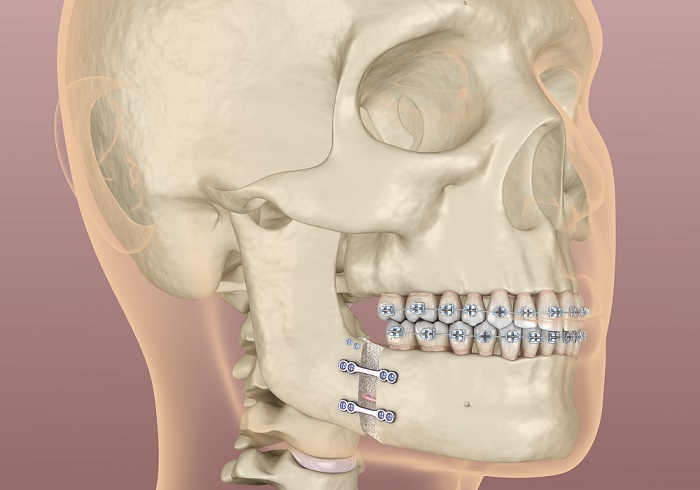
The most common reason for a mandibular osteotomy is to correct severely protruding or receding lower jawbone. It is the most common type of jaw surgery and often follows orthodontic work. An incision is made behind the teeth in the back of the mouth. Then the jawbone is cut and shifted into its new position. Titanium screws and plates hold the jaw in place, and the incisions are closed.
Genioplasty
This is a corrective chin surgery often performed in conjunction with a mandibular osteotomy to restructure the chin line and improve the face’s overall appearance by balancing your features. The tip of the chin bone is cut away from the lower jaw, then moved forward to correct a receding chin, then reattached to the jawbone with titanium plates and screws. If the chin is too prominent, your surgeon will shave away a portion of the jawbone after the tip is removed and reattached in the same manner.
Jaw Surgery for TMJ
Treating temporomandibular joint disorder is a complicated and lengthy process because the hinge of the jaw is the most complex and frequently used joint in the body. There are many treatment options, including exercises, orthodontics, oral appliances, and occupational therapy. However, the problem is so severe in rare cases that either maxillary, mandibular, or combined osteotomy is needed. However, the doctor perform this surgery only when other treatment options have failed or the jaw cannot open or close without help.
Jaw surgery is a difficult procedure with a lengthy recovery period. Your oral surgeon collaborates closely with your dentist, orthodontist, and other specialists to ensure your procedure works with any other treatments you are undergoing or will undergo in the future.
If you have questions about jaw surgery and how it can help you, please feel free to contact our office at Maurice Edwards Oral Surgery Phone Number (212) 888-8624.
Ready to Restore Your Smile?
Comments are closed.